What Is Net Run Rate (NRR) in Cricket? (Explained Simply for Beginners)


If you watch tournaments like the IPL, World Cup, or any league cricket, you must have seen teams with same points but different positions in the points table.
The reason for this difference is Net Run Rate (NRR).
👉 In this article, you’ll learn what Net Run Rate means in cricket, how it is calculated, and why it is so important, all explained in easy words.
If you are new to cricket, first read Cricket Rules Explained Simply for Beginners — it will help you understand this topic better.
What Is Net Run Rate (NRR)? (Simple Meaning)
Net Run Rate (NRR) shows:
How well a team scores runs compared to how many runs it allows the opponent to score
In short:
👉 NRR = Team performance balance
High NRR = team is performing well
Low or negative NRR = team is struggling
Why Net Run Rate Is Important in Cricket
NRR is used to:
Rank teams in a points table
Decide qualification for playoffs
Break ties when teams have equal points
That’s why teams sometimes try to score faster or restrict opponents, even if they already won the match.
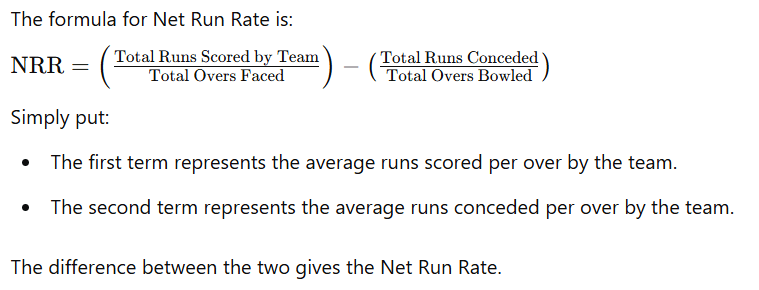
Net Run Rate Formula (Very Easy)
Formula:
Net Run Rate = (Team Runs ÷ Team Overs) − (Opponent Runs ÷ Opponent Overs)
Don’t worry — examples below will make this very clear.
Net Run Rate Example (Simple Calculation)
Match Example:
Team A scores 180 runs in 20 overs
Opponent scores 160 runs in 20 overs
Step 1: Team run rate
180 ÷ 20 = 9.00
Step 2: Opponent run rate
160 ÷ 20 = 8.00
Step 3: NRR
9.00 − 8.00 = +1.00
👉 Net Run Rate = +1.00 (Very good)
What If a Team Loses a Match?
Yes, NRR is calculated even if a team loses.
Example:
Team A scores 150 in 20 overs
Opponent scores 151 in 18 overs
Team run rate:
150 ÷ 20 = 7.50
Opponent run rate:
151 ÷ 18 = 8.38
NRR:
7.50 − 8.38 = −0.88
👉 Negative NRR = poor performance
Net Run Rate in a Tournament (Important Point)
NRR is calculated using ALL matches, not just one.
It considers:
Total runs scored in tournament
Total overs faced
Total runs conceded
Total overs bowled
That’s why one bad loss can affect a team’s NRR badly.
Why Teams Care About NRR So Much
Teams care about NRR because:
Points may be same
NRR decides qualification
One big win can push team up
One heavy loss can drop team down
That’s why you see teams:
Chasing targets faster
Trying to win by big margins
Can NRR Decide Semi-Final or Final Qualification?
Yes ✅
Many times:
Two or more teams finish with equal points
Team with higher NRR qualifies
NRR has decided playoff spots many times in major tournaments.
Net Run Rate vs Run Rate (Common Confusion)
| Run Rate | Net Run Rate |
|---|---|
| One match | Whole tournament |
| Team scoring speed | Team vs opponents |
| Simple | Comparative |
👉 NRR gives a bigger picture
Why NRR Confuses Beginners
NRR feels confusing because:
Formula looks complex
Tournament calculation uses many matches
It’s not shown clearly during matches
Once you understand run rate, NRR becomes easy.
(If needed, read What Is Strike Rate in Cricket? to understand match speed better.)
Final Thoughts (Beginner Summary)
Remember:
NRR compares team scoring and conceding
Positive NRR = strong team
Negative NRR = weak performance
NRR decides rankings when points are equal
Understanding NRR makes points tables and qualifications much clearer.
Frequently Asked Questions
Is higher NRR always better?
Yes. Higher NRR means better overall performance.
Does NRR matter if points are different?
No. Points always come first.
Which formats use NRR?
Mostly ODI and T20 tournaments.
Beginner Question 👇
Cricket Rules Explained Simply for Beginners
What Is Strike Rate in Cricket?
ways a batsman can get out in cricket, explained simply for beginners.
Strike rate becomes crucial during powerplay in cricket.
No comments:
Post a Comment